A watched film isn’t always a diary entry.
I separated two valid intentions: keeping a film in a watched list and recording a particular viewing. The design protects the first while making the second easier to understand.
Independent design study. Not commissioned by Letterboxd. Proposed work, revised October 2026.
“I watched it” can mean two different things.
“I saw it years ago, but I don’t remember when.” “I watched it yesterday and want it in my diary.” The same film can lead to two valid records. I used these scenarios to frame the problem; they are authored examples, not interview quotes.
Letterboxd already distinguishes a watched flag from a dated Diary entry. Its help explanation establishes that distinction. The reviewed watched flow also keeps Watch and Review or log separate. These sources establish the model, not the frequency of confusion.
My first decision was to protect the undated outcome. More diary entries would be a poor result if the design encouraged people to invent dates. I focused on people who have marked a film watched and are deciding whether they also want to record a particular viewing.
A prominent invitation can become an unfinished chore.
My earlier proposal put “No diary entry yet” above a large green Log a viewing button. Reviewing that hierarchy exposed a contradiction: the text defended undated viewing, while the screen treated it like unfinished work.
I considered three directions: automatically open the composer after Watch; keep the prominent logging prompt; or acknowledge the watched record and offer a separate diary action. I chose the third. It preserves a clear exit and makes the next step optional. The trade-off is a less prominent logging invitation.
The revised action sheet says “Kept in your watched films. A date is optional.” Done remains a complete, ordinary action. Add a diary entry is available without turning the existing record into a warning. Rating, lists and sharing remain separate choices.
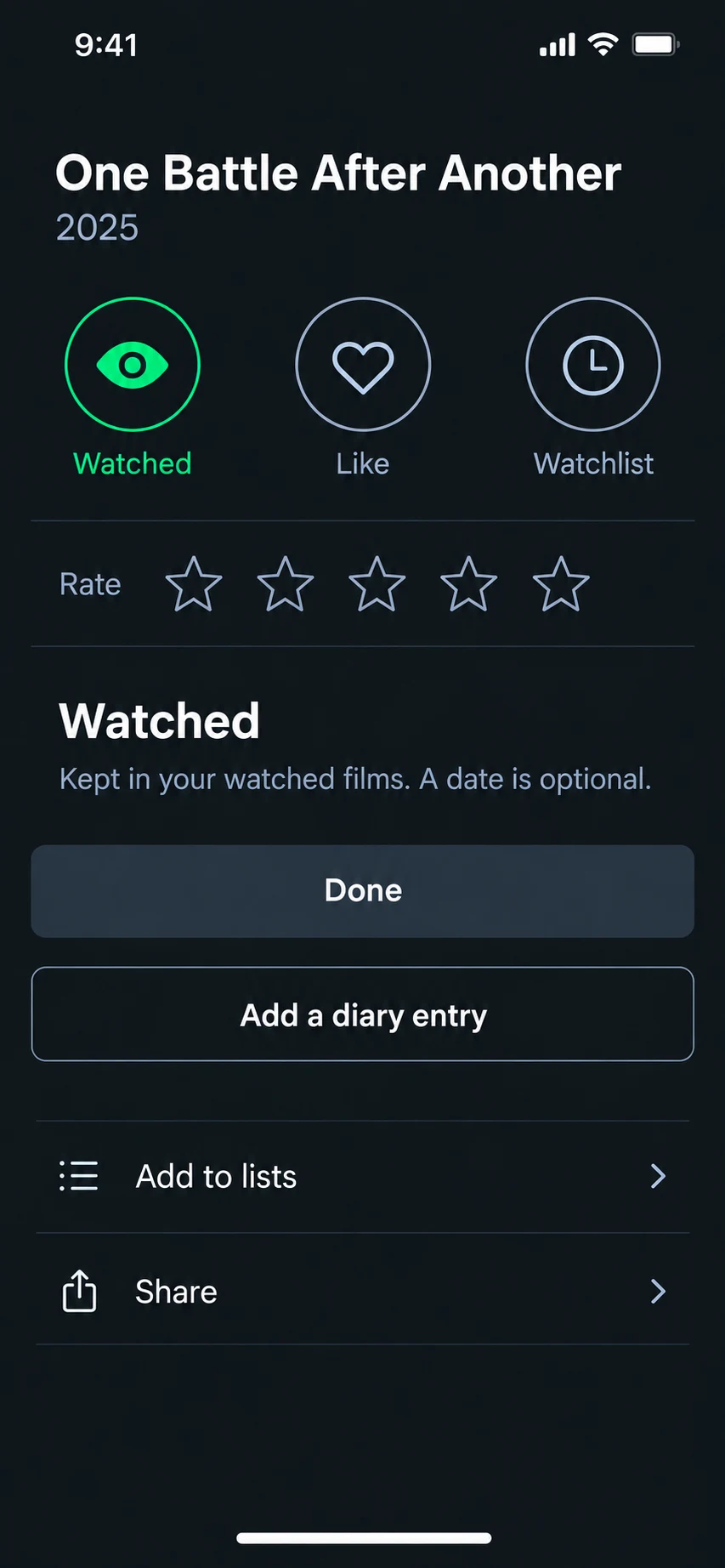
I made Done an ordinary exit because choosing not to log a date is a valid result. A stronger logging prompt would be easier to notice, but could imply that the watched record is unfinished.
Authored proposal · Neutral completion preserves an undated watched record. Sample film data; optional rating remains available. This is not a released Letterboxd screen.This is an authored reconstruction with sample film data, not a screenshot of a shipped Letterboxd change. I have revised the hierarchy; I have not yet established that people interpret it as intended.
A film, a viewing and a review are different things.
I used a conceptual model to check the interface: a film can be watched without a known date; a viewing records an occasion; a review adds optional expression. This is a design model, not a claim about Letterboxd’s internal database.
That distinction changes the success criterion. A person who chooses Done without a diary entry may have completed their task perfectly. A person who chooses yesterday needs the correct dated record, not just a success message.
“I have seen it.”
No date required.
“I saw it on this day.”
A deliberate date choice.
“This is what I thought.”
Never a condition of logging.
Show what the date choice creates.
I leave the date empty until the person chooses one. That adds an action for a same-day logger, but removes a silent assumption for backfilling. The composer below shows the next state, after an explicit choice of 7 October. “I don’t know the date” preserves a route back to the undated watched outcome.
The existing composer already supports date, rating, review and tags; my contribution is the handoff and date hierarchy, not the invention of those capabilities. The reviewed composer is the reference boundary. I retain optional expression and audience controls instead of making a date choice look like a requirement to write a review.
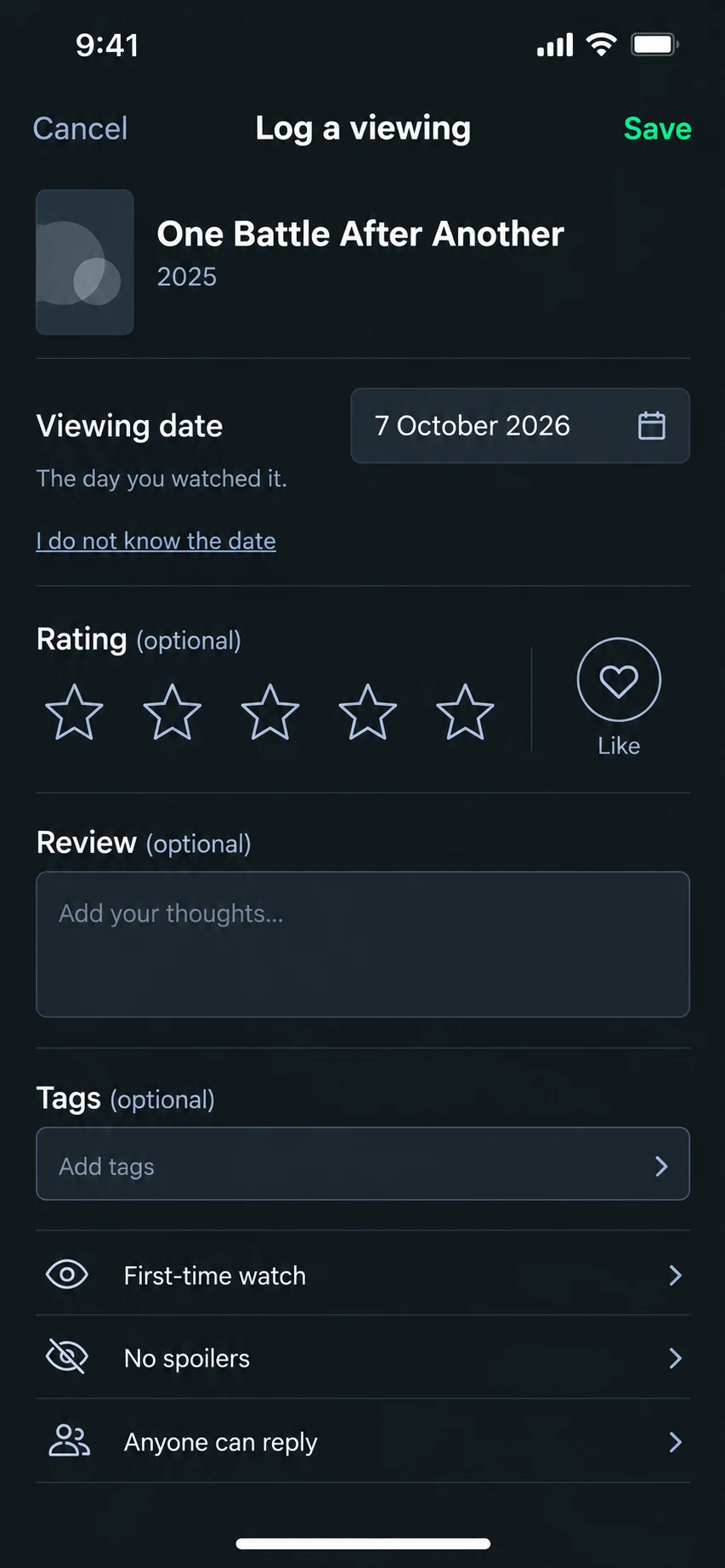
I left the date unset at entry; this frame shows it after the person selected 7 October. That costs a same-day logger one choice, but protects backfilled records. Unknown dates have a way back to watched.
Authored proposal · Sample film and date. Rating, review, tags and audience controls remain separate from the date choice.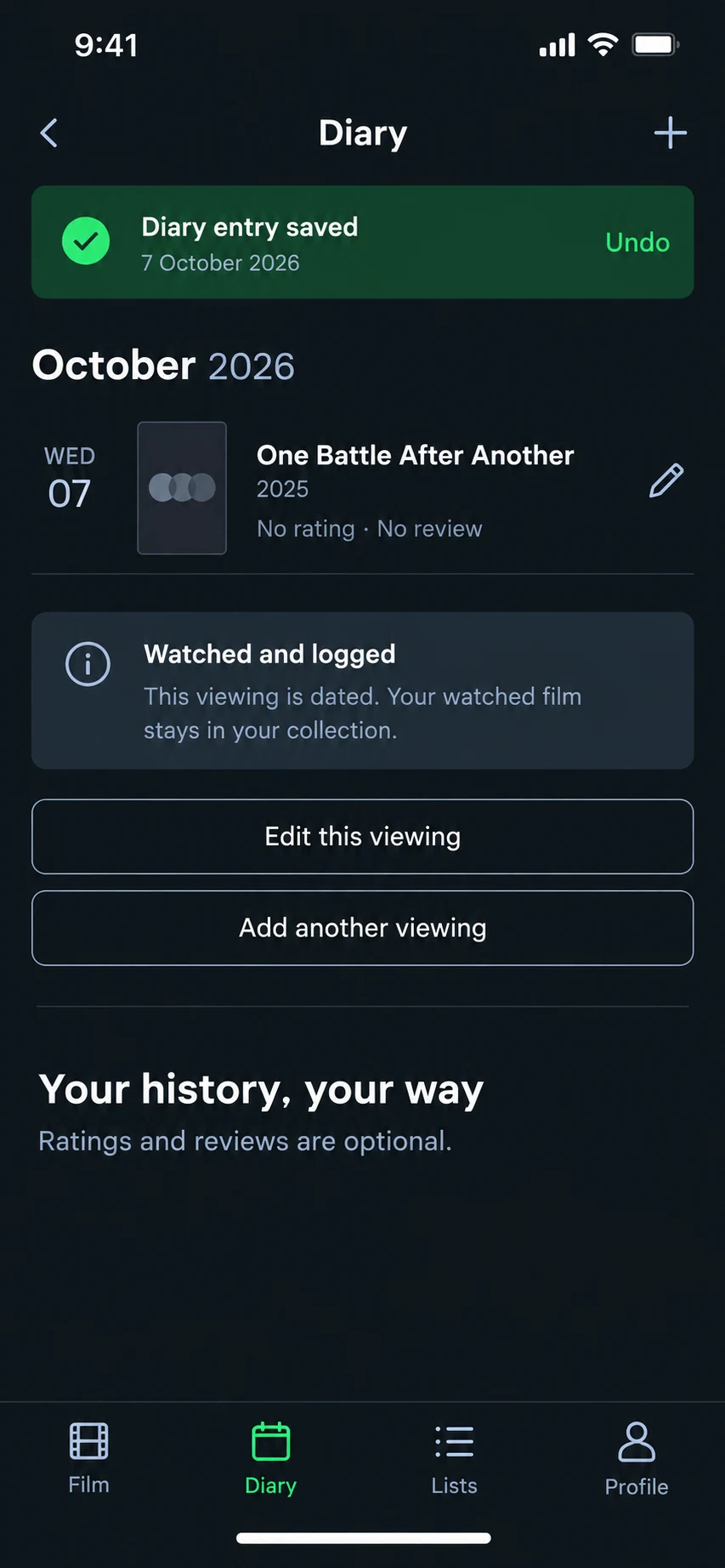
I show the date in Diary and keep Edit and Undo beside the result. A generic success toast would confirm the action without helping someone notice a wrong date.
Authored outcome · Sample dated viewing. Neither a rating nor a review is required.The saved state is part of the decision, not decorative confirmation. Showing the selected date in Diary lets someone verify the record; Edit and Undo make correction visible. These frames specify a proposed flow using sample data. They do not demonstrate persistence or connect to a Letterboxd account.
A retry is not a second viewing.
The duplicate question belongs to the person’s intent. A failed request retried with the same operation must not create another entry. Watching a film twice can legitimately create two entries, even on the same day.
| Situation | Decision | What the interface must explain |
|---|---|---|
| Date is unknown | Keep watched without a date | No diary entry is required |
| The same submission is retried | Reconcile the original operation | Whether that entry was accepted |
| A matching entry already exists | Offer to edit it or record another viewing | Enough of the existing record to make the choice |
| The person changes the date | Update the intended viewing | Which entry changed; how to undo |
I would keep duplicate detection advisory for ambiguous cases. Hard blocking would make the database cleaner at the expense of a valid rewatch. Conversely, a generic “Save again” would hide the distinction.
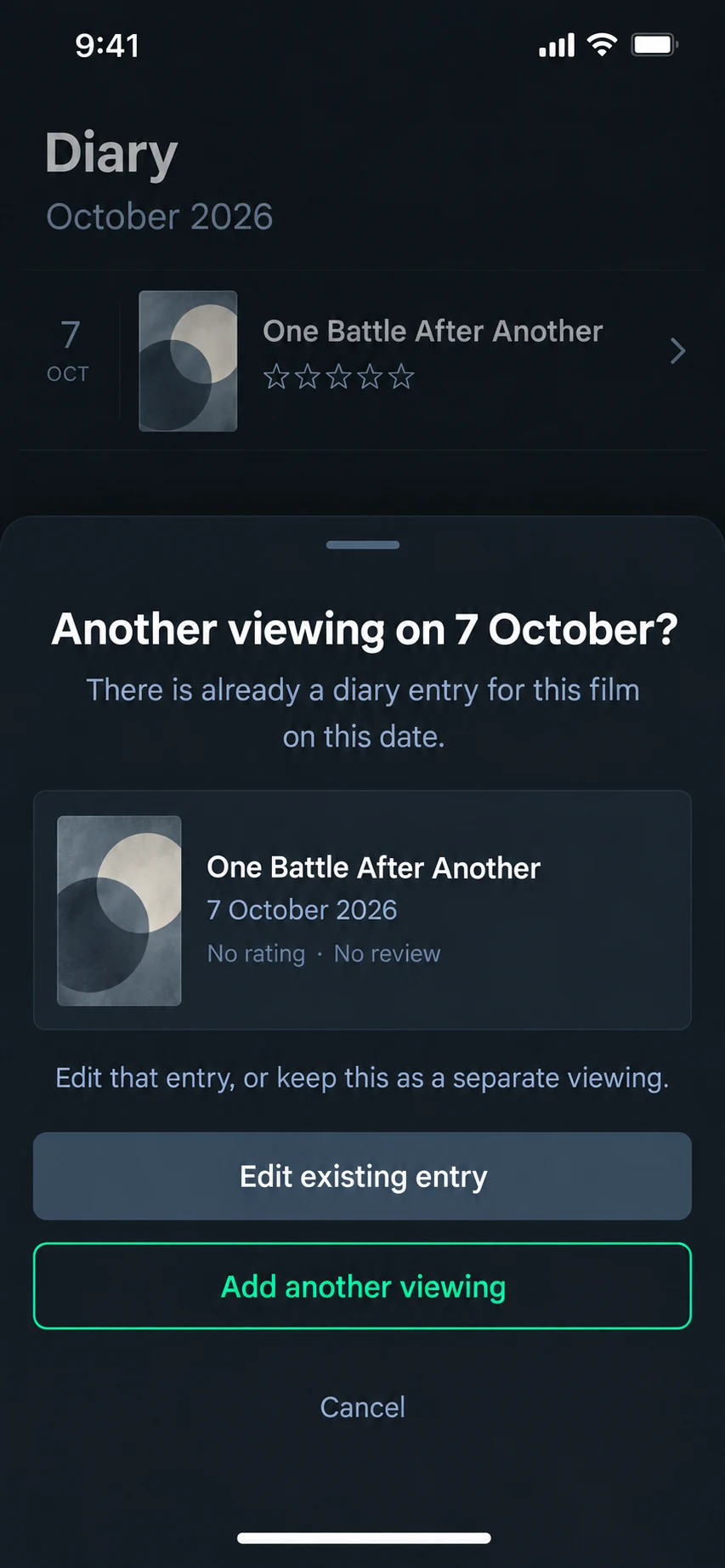
I surface the matching date and the existing entry before offering Edit or Add another viewing. I chose an advisory check because two viewings on one day can both be valid.
Authored exception · Illustrative same-day match. Network retries still require separate duplicate-operation protection.Correct records matter more than additional records.
I would test the revised flow with people who log regularly, people who backfill and people who mainly use watched lists. Tasks would include yesterday, an unknown date, a deliberate rewatch and a timeout. The primary prototype question is whether the stored outcome matches the person’s intention.
I would record the chosen date and record type, ask what the person expects to find in Diary, and observe correction without coaching. Counterbalancing the alternatives would reduce order effects. These are planned sessions, not completed research.
The design should change if the neutral action is still read as an obligation, if date selection slows familiar logging without improving accuracy, or if people cannot distinguish editing from another viewing. I would not explain those errors away with an increase in Save taps.
Personal history is useful when people can trust it.
Diary entries can support retrospectives and the statistics described in Letterboxd’s Pro offering. Incorrect dates weaken that value. The commercial mechanism is therefore conditional: a trustworthy record may make returning more useful; it does not automatically create paid conversion.
I removed the earlier uplift chart from the main story because multiplying a hypothetical percentage by a hypothetical audience did not establish that mechanism. The smaller decision is whether the revised handoff improves understanding enough to justify an additional date choice.
What I changed in this revision is concrete: neutral completion, an explicit date decision, an editable outcome and a visible distinction between retry and rewatch. What remains open is how people use that model in practice. That is the next evidence this case needs.