Give saved ideas a reason to return.
I treated a review invitation as a decision about attention: who wants it, what it promises, where it belongs and what happens when someone declines.
Independent design study. Not commissioned by Headway. Proposed work, revised October 2026.
A bookmark can be a collection, a reminder or a plan to practice.
Headway already has saved material and repetition functionality. The reviewed Library flow and saved-card flow are reference points, alongside the product FAQ. My contribution is a proposed invitation and return path, not the invention of spaced repetition.
I considered three explanations for a saved insight that is never reviewed: the person cannot find review, does not understand its value, or never intended to review. Only the first two support an invitation. More prominent placement would not solve the third.
The initial audience is therefore people with saved insights who express an interest in revisiting them. Save alone is a weak signal. In a pilot, an optional choice after saving could establish interest before the feed makes a recurring request.
Describe the next useful action without promising a better memory.
I compared “Improve your memory,” “Keep your streak,” and “Return to your saved ideas.” The first asserts an outcome this study cannot establish. The second rewards a behavior without explaining its value. I chose the third because it connects the invitation to material the person deliberately kept.
“Review 3 insights” defines the immediate scope. It does not promise that three cards will improve retention or that the session will take an exact time. The sample count comes from this concept’s fixture, not a measured account or a scheduling algorithm.
That wording sacrifices urgency. It is an intentional trade-off: people should understand the activity before entering it, and declining should not be framed as losing progress.
Adding a card also moves something else.
My previous comparison removed categories to make room for the invitation. That contradicted the claim that this was an additive change. The revised proposal keeps the daily mission, categories, recommendations and bottom navigation, with one bounded review slot between mission and categories.
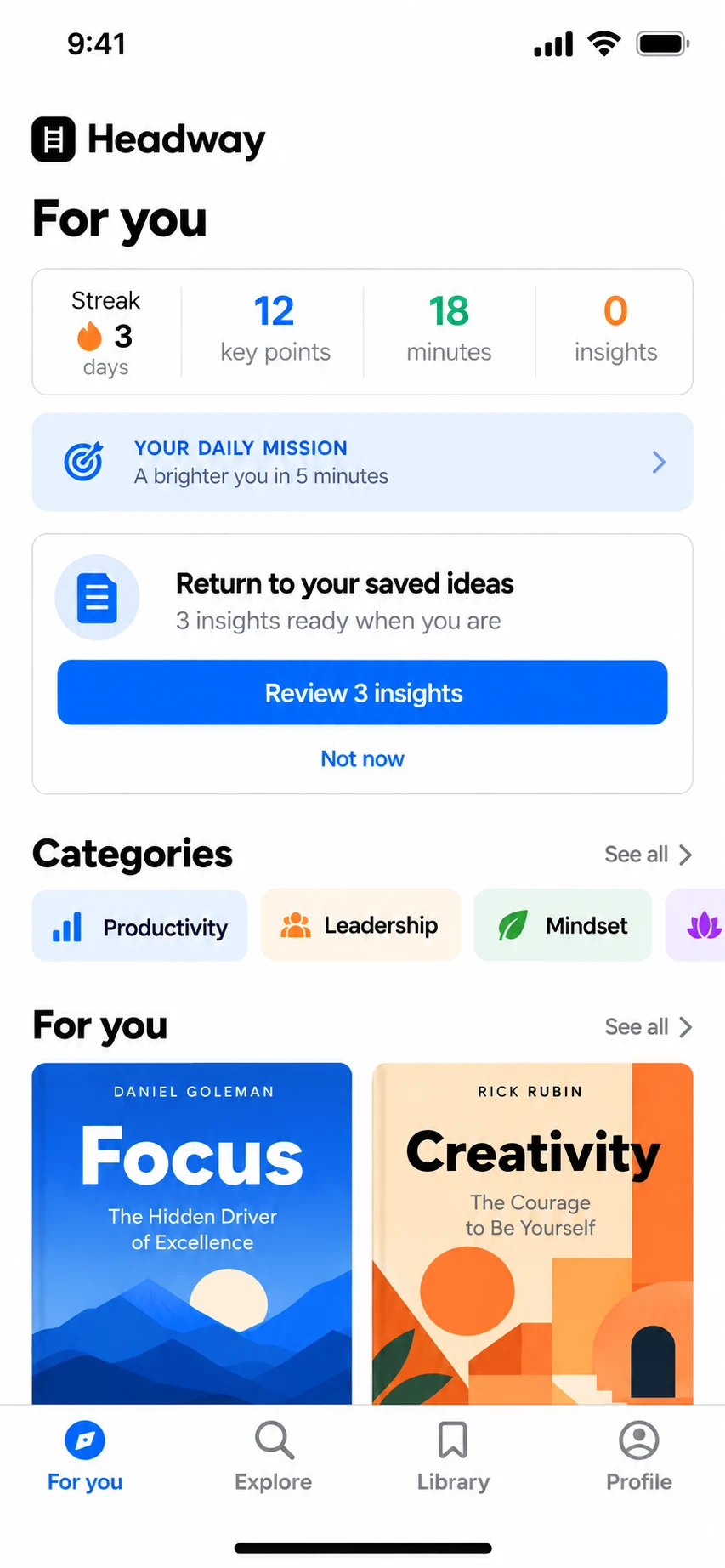
I chose Review 3 insights to describe the activity and its scope. Keeping categories exposes the real trade-off: this slot still pushes discovery lower, so a higher tap rate alone would not justify it.
Authored reconstruction · Sample counts and illustrative book artwork. Not a pixel-identical baseline.This is an authored reconstruction, not a pixel-identical baseline or a released screen. Recommendation artwork and counts are illustrative. Preserving destinations does not make the change free: categories and books move lower, so a tap-rate win can still damage the reading journey.
I would compare this slot with a Library-only invitation and an invitation immediately after saving. The latter has strong context but may interrupt reading; the feed has reach but spends discovery space; Library is quieter but may miss people who rarely open it. That is the decision, not which blue button looks best.
Show the activity the invitation promises.
I considered opening straight onto the saved sentence, asking for a typed answer, and offering a quiet recall prompt before reveal. I chose the prompt. It leaves room to try recalling without introducing an assessment or extra input the invitation did not promise.
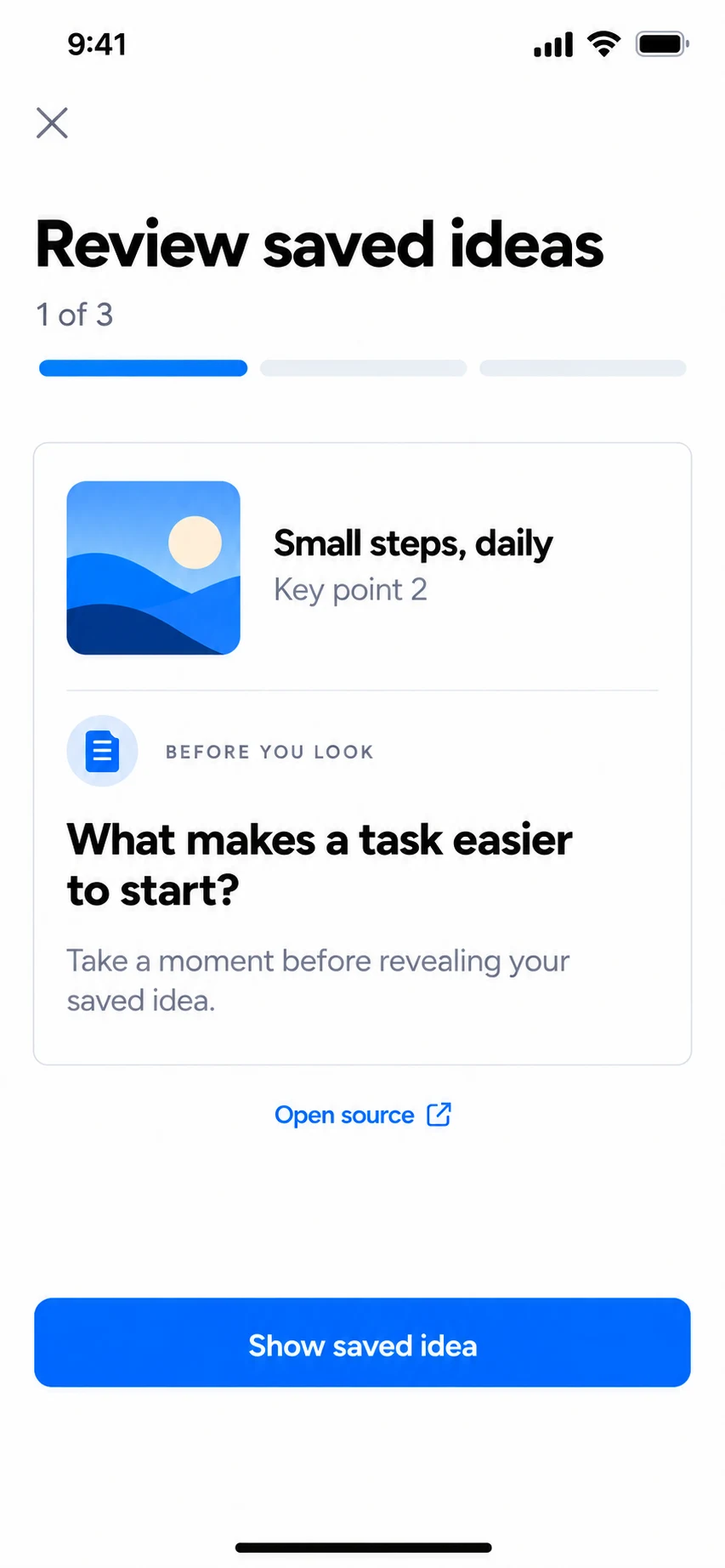
I begin with a question and an explicit Show saved idea action. Revealing the answer immediately would remove the opportunity to recall; requiring a typed answer would add effort this lightweight invitation did not promise.
Authored proposal · Small steps, daily and its content are original fictional samples, not a published book or quotation.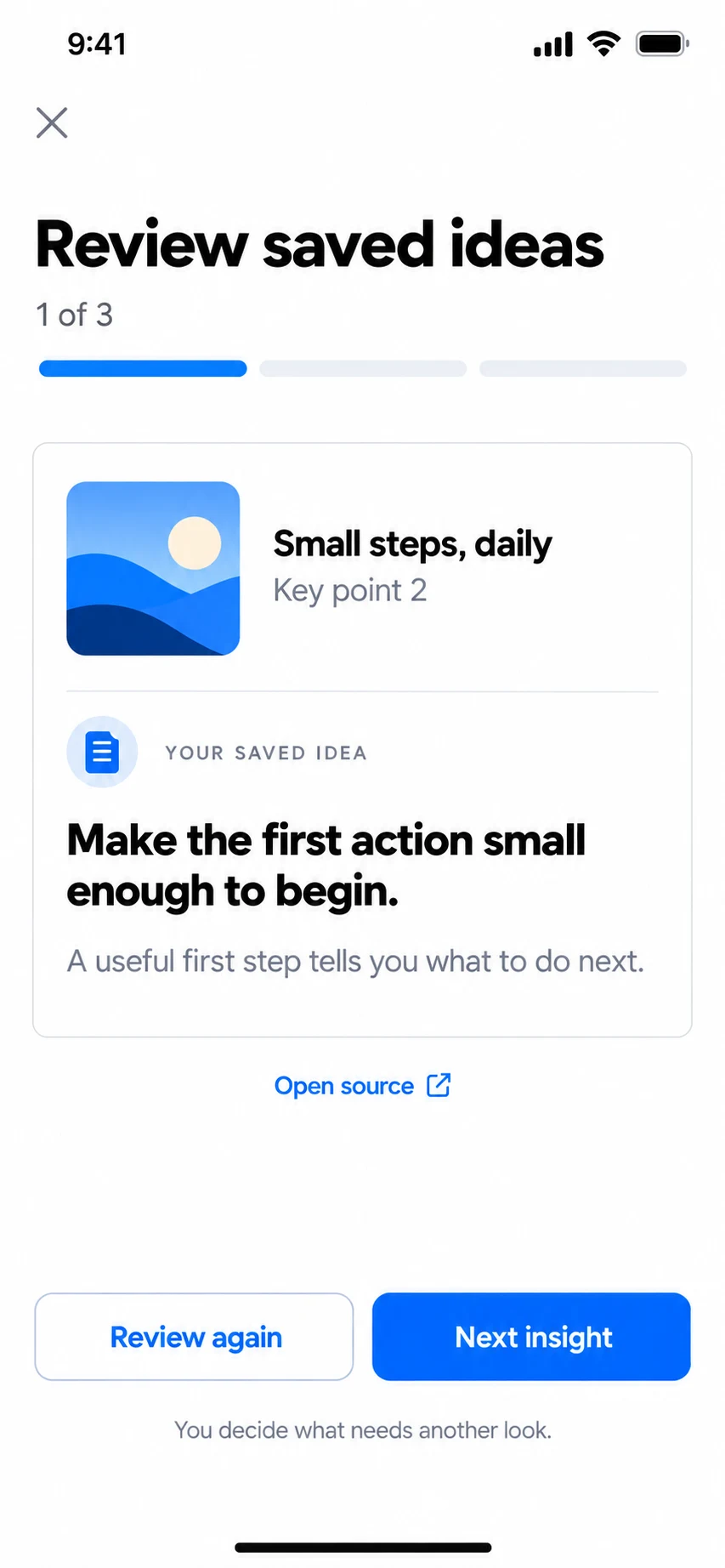
I keep the source, question context and progress in place when the saved idea appears. Review again and Next insight let the reader choose; I do not infer mastery from revealing a card.
Authored reveal · Same fictional source and first card as the preceding screen; no recall or learning result.These are consecutive states of the first card. “Small steps, daily” and all three ideas in this sequence are original fictional samples, not published book content or quotations. Keeping the source title and key-point location visible lets the reader recover context. Revealing a sentence is an action; it is not proof that the person remembered or understood it.
The final frame follows all three cards. I show the reviewed items and a direct return to reading, rather than a mastery score, streak warning or mandatory reminder. That is how the ending honors the bounded promise made by “Review 3 insights.”
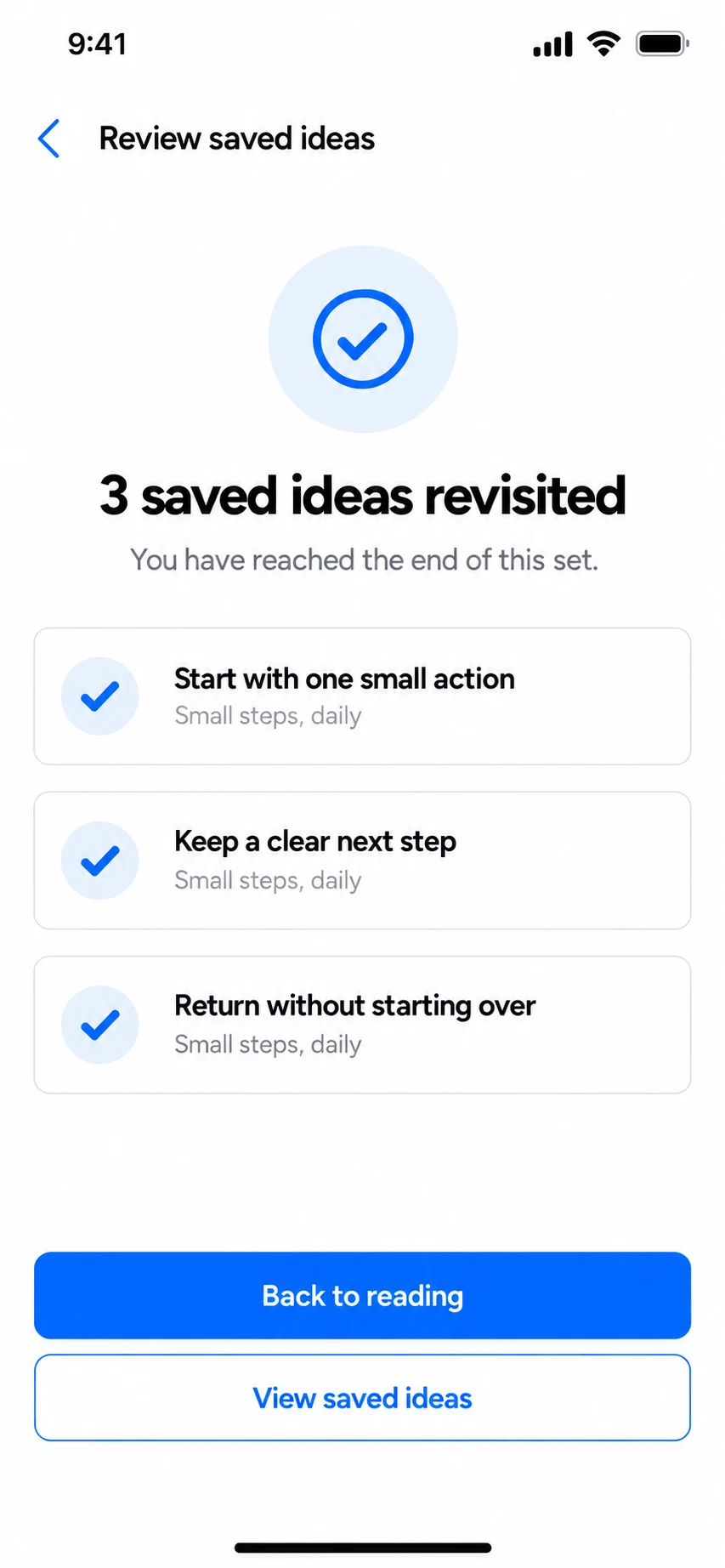
After all three cards, I show what was revisited and offer Back to reading. I rejected an obligatory reminder or another session because the invitation should deliver the bounded activity it promised.
Authored outcome · Shown after all three sample cards, not after revealing only the first one.A failed save must not produce a review-ready claim. A deleted insight must leave the queue. If the source is no longer accessible, the interface should explain that limitation rather than offering a dead link. These are proposed consistency rules, not claims about the current backend.
Repeated dismissal should change the invitation.
I propose that “Not now” removes this invitation for the current visit. A separate “Hide review invitations” preference suppresses recurring feed prompts while leaving review available in Library. A future reminder would require an explicit, separate choice.
I rejected repeated modal reminders and a streak warning. Both could increase immediate response while hiding whether the activity is wanted. An invitation that needs more pressure each time may be a poor fit for the audience or moment.
Frequency should be tested rather than asserted as an optimal seven-day rule. The important contract is comprehensible control: dismiss now, hide recurring prompts, and restore the preference later. No notification permission is required to use the proposed flow.
Review adoption has an opportunity cost.
The decision metric would combine voluntary review completion with repeat use and the effect on reading. I would report exposure, acceptance and completion separately, then check whether existing reading starts and returns deteriorate. People who hide the prompt remain in the assigned-group analysis.
For the first pilot I would prioritize newly paid members who saved material and explicitly expressed interest in revisiting it. Trial members need a separate value-discovery question; mature subscribers may already have a routine. A repeated, useful return before renewal is a plausible mechanism for subscription value, not evidence of willingness to renew. Ongoing content references, scheduling rules and preference maintenance also have a cost.
A controlled rollout could test behavior if product access becomes available. A prototype can establish whether the invitation and review flow are understood; it cannot establish retention or learning. A claim about memory would require a different study with an appropriate recall measure and comparison.
I would remove the feed slot if it mostly creates accidental starts, if repeat use disappears without prompting, or if it displaces more valuable reading. A successful design may end up as a better Library entry and a quieter post-save explanation. The business case depends on sustained value, not an assumed percentage uplift multiplied by the whole user base.